
El Dato Logístico: a live editorial system built with AI agents
In logistics, foreign trade and transport, information isn’t what’s missing.
What’s often missing is time to turn that information into judgment.
There’s news, resolutions, market data, cargo movements, road closures, port reports, social posts, official statements, databases, technical documents and scattered conversations. It all shows up in different places, at different rhythms and with different levels of reliability.
The challenge isn’t to accumulate more sources. The challenge is to build an editorial capability that can observe, filter, interpret and turn signals into useful pieces.
That’s the case of El Dato Logístico: an editorial system supported by AI agents to monitor topics, organize information, propose angles, write articles, edit pieces and build live reports on logistics and transport.
It isn’t just a media outlet. It’s an example of how artificial intelligence can help create an editorial operation that’s more consistent, more traceable and more connected to data.
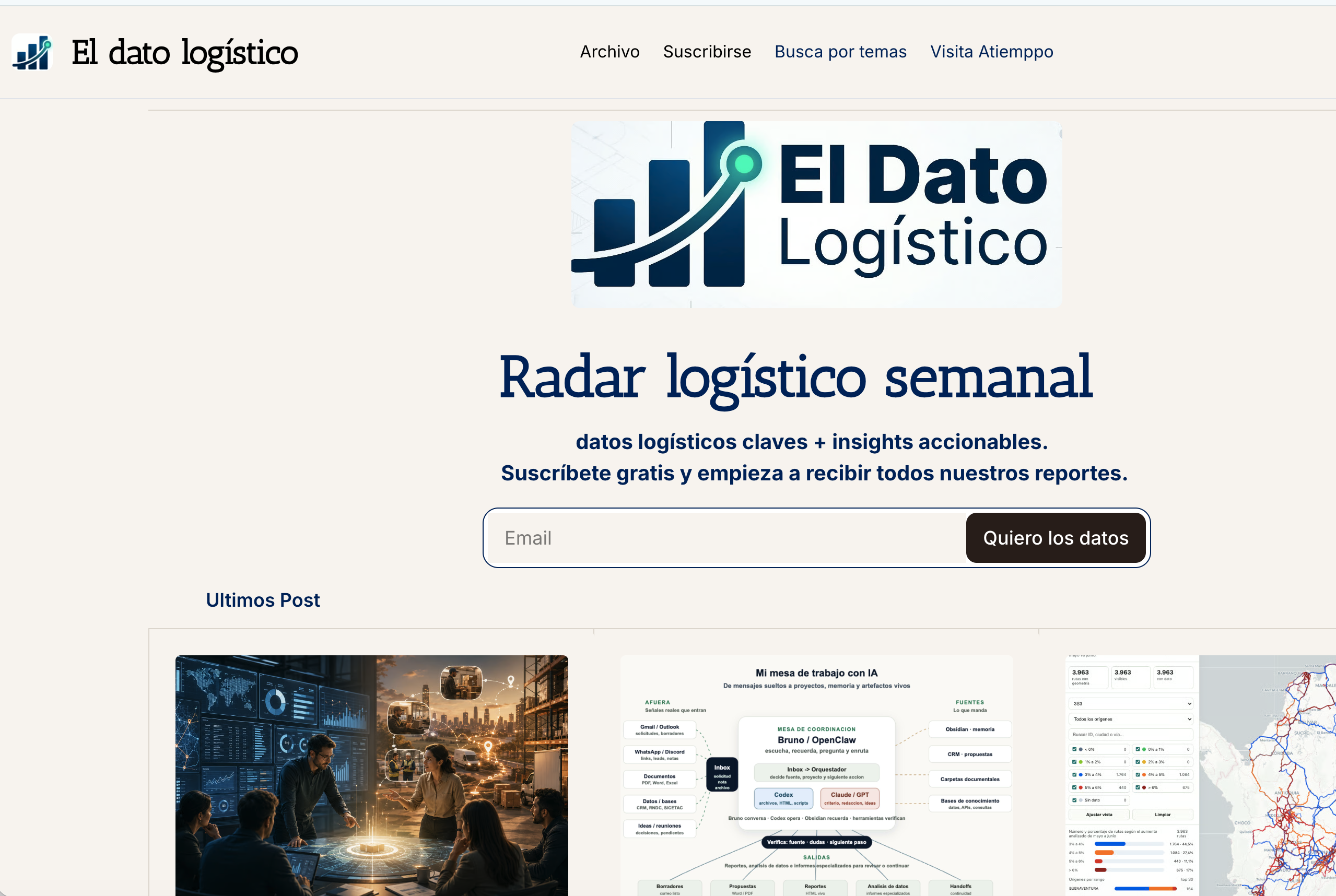
You can visit the project at eldatologistico.com.
The problem: too much information, little editorial time
The logistics sector moves on fragmented information.
A blockade may appear first on social media.
A trend may be hidden in a database.
A commercial opportunity may come out of a regional news story.
A regulatory change may be buried in a PDF.
A technical conversation can become an article if someone organizes it.
For an editorial team, that creates constant pressure: check sources, separate signal from noise, decide what’s worth covering, write clearly, keep continuity and publish at a steady pace.
Doing it manually is possible, but it consumes time and becomes irregular.
That’s where agents make sense.
Not to replace editorial judgment, but to sustain the operation that lets that judgment show up faster and with better inputs.
What El Dato Logístico does
El Dato Logístico works as a lab for applied editorial AI.
Its work combines monitoring, curation, writing, editing and the building of topic memory.
In practice, that means:
- detecting relevant signals in open sources;
- reviewing social media, outlets, documents and data;
- prioritizing topics with editorial potential;
- proposing angles for articles or reports;
- writing initial drafts;
- editing pieces to improve clarity, tone and factual support;
- maintaining topic maps;
- turning findings into live reports;
- building a reusable knowledge base for new pieces.
The value isn’t only in producing text. It’s in creating a work chain.
A signal enters the system. It’s evaluated. It’s contrasted. It becomes a proposal. Then a draft. Then an edited piece. And, when it applies, an input for reports, maps or future analyses.
That’s very different from asking an AI to “write an article.”
An editorial map, not a list of loose ideas
One of El Dato Logístico’s strongest opportunities is building an editorial map.
The map allows you to organize the topics that matter for the sector:
- road infrastructure;
- ports and foreign trade;
- cargo transport;
- logistics costs;
- fuels;
- regulation;
- RNDC and SICETAC data;
- corridor behavior;
- technology applied to logistics;
- companies, trade associations and public decisions;
- regional signals that can affect operations.
That map prevents the editorial system from depending only on the day’s inspiration.
It makes it possible to know which topics are being followed, which sources feed each line, which questions are still open, which pieces have already been published and which data can be reused.
For a company, this shows a broader idea: AI can help turn scattered knowledge into a work agenda.
Articles with support, not generic content
El Dato Logístico also shows an important difference between using AI to generate content and using AI to build content with support.
A useful article doesn’t come from a random idea.
It needs:
- a clear question;
- verifiable sources;
- sector context;
- data when it exists;
- editorial reading;
- limits on what can’t be stated yet;
- editing so the text is understandable and publishable.
Agents help at every stage. A monitor can bring signals. A curator can prioritize. A writer can structure the argument. An editor can adjust tone, clarity and consistency. Bruno can coordinate the flow and decide what’s missing before closing.
AI doesn’t eliminate the editorial process. It makes it more visible and more repeatable.
Data and live reports
The other key component is data.
El Dato Logístico doesn’t limit itself to commenting on news. It can work with databases, indicators, historical series, documents, public sources and reports that update.
That makes it possible to build live reports: pieces that aren’t just a single day’s publication, but assets that can grow with new information.
A live report isn’t a static PDF or a note that’s published and abandoned. It’s an active editorial piece: it integrates signals, data, sector context and temporal tracking so the reader understands not only what happened, but how the topic evolves and what it might imply.
A road closure, a port alert, a cost variation, congestion or a regulatory decision can enter the system as initial signals. Then they’re contrasted with sources, organized editorially and updated as new evidence appears.
The difference from a traditional article is continuity. The live report keeps structure, memory and tracking: what changed, what stayed the same, what lost relevance and what deserves attention.
That format can include editorial maps, timelines, comparative tables, status indicators, simple visualizations, traceable sources and an executive reading for deciding quickly.
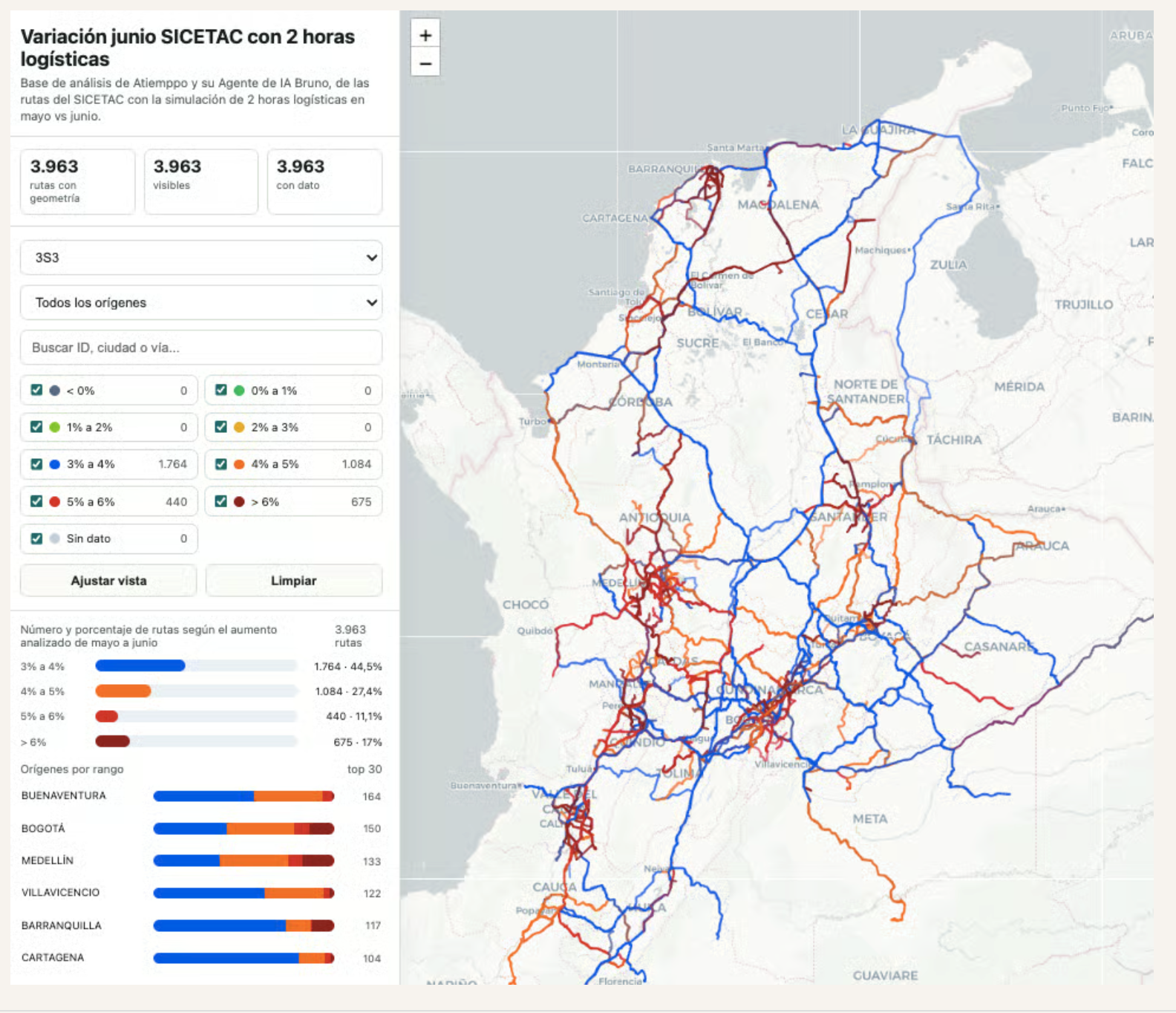
That opens a powerful commercial possibility: many organizations don’t just need “a report.” They need systems that keep information live, queryable and updated.
An editorial factory with specialized agents
El Dato Logístico shows well the value of not having a single generic agent.
The system works better when each agent has a clear function:
- monitors to look for signals on the web, X, Instagram, TikTok or other sources;
- curators to decide what has editorial value;
- writers to turn proposals into drafts;
- editors to improve clarity and support;
- data agents to query databases or indicators;
- Bruno as the orchestrator that connects the parts and verifies that the flow advances.
That model looks more like an AI-assisted newsroom than a chatbot.
And that’s exactly the opportunity: designing agents that collaborate around a real process.
Why this case matters for Atiemppo
El Dato Logístico is a very valuable case to show on Atiemppo’s website because it brings several capabilities together in one story.
It shows that agents can:
- monitor recurring sources;
- sustain topic continuity;
- work with data and documents;
- propose angles;
- write and edit;
- build live reports with updates, traceability and executive reading;
- keep an editorial memory;
- coordinate tasks between specialists.
That lets us sell an idea bigger than “we automate content.”
The real idea is: we build applied-intelligence systems to produce useful knowledge continuously.
That message works for media, trade associations, logistics companies, consultancies, strategy areas, commercial teams and organizations that need to understand their environment better.
From outlet to replicable model
Although El Dato Logístico is born from logistics, the pattern can be replicated in other sectors.
A company might need a similar system to:
- monitor regulation;
- track competitors;
- analyze clients and opportunities;
- detect risks;
- produce reports for the board;
- keep a market map up to date;
- turn internal data into executive readings;
- prepare technical or commercial content with support.
The model is the same: sources, criteria, agents, memory, editing and deliverables.
The difference is the domain.
AI with editorial judgment
The risk of using AI for content is producing text that looks correct but is empty.
El Dato Logístico aims for the opposite: using AI to increase judgment, not to fill space.
That means verifying, flagging doubts, prioritizing, editing and connecting each piece with a topic agenda.
A good AI-supported editorial system doesn’t publish more for the sake of publishing. It publishes better because it observes more, remembers more, compares more and arrives with better inputs at the moment of writing.
A demonstration of operational intelligence
El Dato Logístico isn’t just an editorial project. It’s a demonstration of operational intelligence applied to knowledge.
It shows how Bruno, OpenClaw and specialized agents can transform an open need —understanding what’s happening in logistics— into a process:
- monitor;
- curate;
- write;
- edit;
- publish;
- feed memory;
- update reports;
- start again with more context.
That continuity is the difference between an AI test and an installed capability.
The commercial opportunity
For Atiemppo, El Dato Logístico can work as a showcase for a clear offer:
AI agents and systems to turn scattered information into actionable knowledge.
That can take the shape of:
- sector observatories;
- live reports;
- market radars;
- internal editorial systems;
- competitive intelligence;
- regulatory tracking;
- risk monitoring;
- technical content production;
- queryable knowledge bases;
- assistants for strategy or communications teams.
It isn’t about replacing analysts, journalists or experts.
It’s about giving them a better work infrastructure.
The deeper value
El Dato Logístico sums up a central thesis of Atiemppo:
AI becomes useful when it connects with a real operation.
In this case, the operation is editorial and analytical. There are topics to follow, sources to read, data to review, pieces to write and reports to keep live.
Agents make that process more consistent, more organized and more traceable.
That’s what we want to show: not an AI that improvises text, but an AI that helps build judgment, memory and continuous production.
In logistics, that can turn into better articles.
In a company, it can turn into better decisions.
Live project
El Dato Logístico shows how an editorial operation can become a live system of sector intelligence.
Visit the project or go back to the flagship article to see how we connect vision, agents, data, content and applied cases.
Visit El Dato See the full series