Bruno and OpenClaw: an AI that doesn’t just answer, it does
For a long time, the conversation about artificial intelligence has centered on one narrow question: how well can a model answer.
That question matters, but it isn’t enough.
Inside companies, value shows up when AI can help move real work: review information, check sources, prepare documents, monitor signals, coordinate tasks, generate reports, trigger workflows and leave evidence of what it did.
That’s the point of Bruno, our assistant built on OpenClaw: an AI designed to get things done.
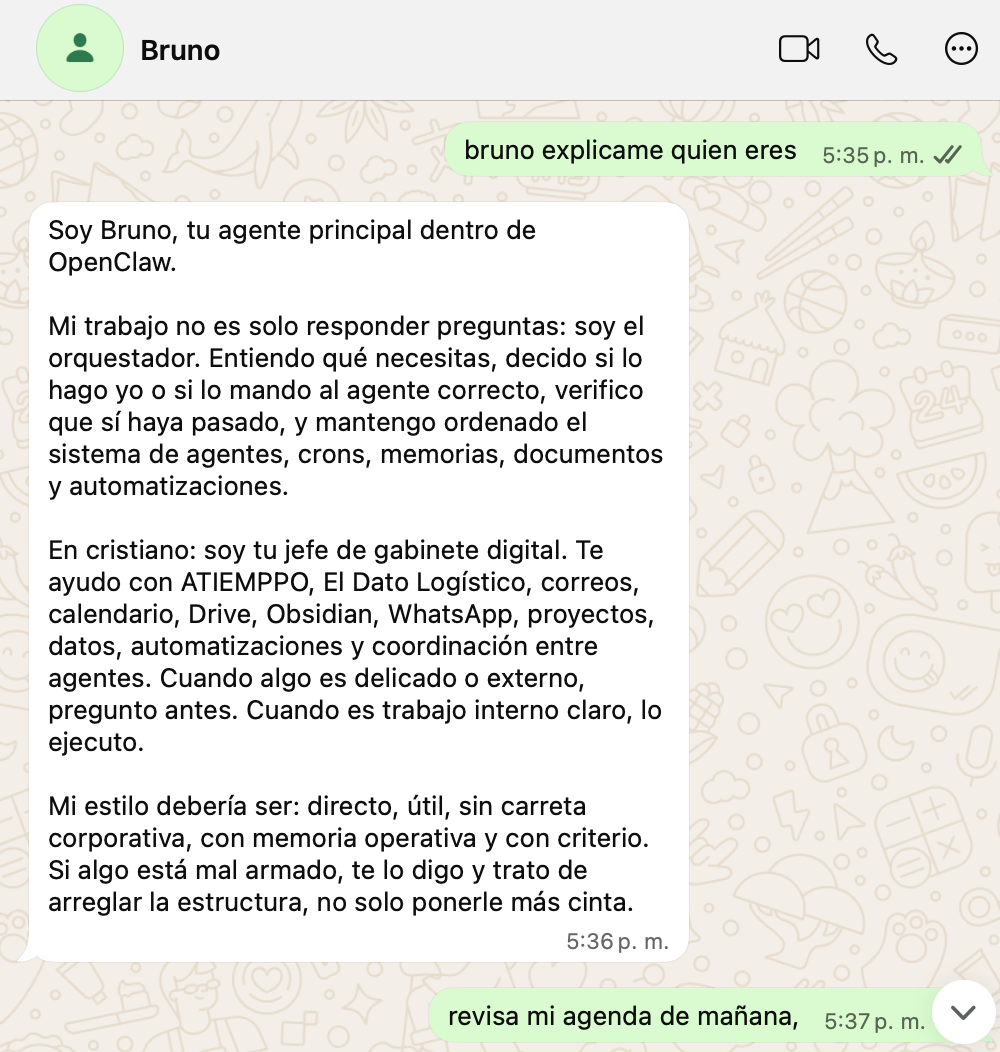
From chatbot to operational agent
A chatbot answers. An operational agent works inside a context.
The difference looks small, but it changes everything.
Bruno doesn’t exist just to chat. It exists to understand a request, decide which tool or agent should step in, execute a task, verify the result and deliver a useful output.
It can prepare an article, review a folder, check an email, send a document, trigger a monitoring flow, coordinate with a specialized agent, check whether a cron ran, look for evidence in a database, summarize a meeting or get an input ready for publishing.
The idea isn’t for a single AI to do everything. The idea is for Bruno to act as an orchestrator: it understands the goal, chooses the path and coordinates capabilities.
What OpenClaw is in this approach
OpenClaw is the layer that lets you take AI beyond conversation.
Instead of an isolated model, it lets you work with agents connected to tools, memories, channels, files, calendars, emails, databases, web sources and scheduled flows.
That opens up a practical difference:
- the AI can remember operational instructions;
- it can work with real sources;
- it can use specific tools;
- it can execute tasks in authorized work channels, such as email, messaging or internal spaces;
- it can coordinate specialized agents;
- it can run recurring processes;
- it can leave traceability of files, reports or deliverables.
For a company, that means AI stops being a chat window and starts becoming an operating layer.
Specialized agents, not generic assistants
Most companies don’t need “an AI for everything.” They need agents that understand specific processes.
An agent for road monitoring. An agent to review commercial emails. An agent to monitor client signals. An agent to query a logistics database. An agent to write editorial pieces. An agent to prepare periodic reports. An agent to help sales teams turn scattered information into action.
Each agent can have:
- a clear role;
- defined sources;
- operating rules;
- safety limits;
- working memory;
- specific tools;
- expected deliverables.
That design reduces improvisation. Instead of asking a generic AI to “see what it finds,” you build a flow with purpose, sources and output.
What Bruno can do
Bruno can operate as a coordination layer for many kinds of work.
Inside a company, that can look like this:
- prepare commercial documents from internal inputs;
- monitor public sources and deliver periodic reports;
- review emails and separate the urgent from the informative;
- query databases and turn results into executive reading;
- generate drafts for web, newsletters or social;
- coordinate research, writing and editing agents;
- remember tasks, commitments and follow-ups;
- prepare delivery packages;
- check whether an automation actually produced the expected file, message or report;
- connect information across areas without relying on manual searches.
What matters isn’t the list. What matters is the pattern: Bruno helps move from intention to execution.
Opportunities for companies
Many organizations already have enough information to make better decisions, but that information is scattered.
It’s in emails, files, spreadsheets, chats, databases, shared folders, web pages, public reports, PDFs, internal systems and team conversations.
The heavy lifting isn’t always producing more information. Often it’s finding it, organizing it, validating it, turning it into judgment and delivering it at the right moment.
That’s where AI agents have a huge opportunity.
They can help:
- reduce repetitive tasks;
- speed up reporting;
- improve commercial follow-up;
- detect early signals;
- prepare inputs for meetings;
- watch for changes in external sources;
- turn data into explanations;
- keep continuity across conversations and decisions;
- run recurring processes without depending on human memory.
The promise isn’t to replace teams. The promise is to give them a support layer that works with context, speed and traceability.
Practical cases, not demos
At Atiemppo we want to sell AI projects starting from concrete cases.
Not from the hype. Not from a slide deck full of concepts. From real problems a company recognizes instantly:
- “I need to know what happened without checking twenty sources”;
- “I need someone to prepare the report for me every morning”;
- “I need to turn this database into useful answers”;
- “I need to monitor commercial signals”;
- “I need my documents, emails and data to talk to each other better”;
- “I need an AI that follows up, not just one that answers nicely.”
Bruno and OpenClaw make it possible to build that kind of solution: agents that plug into daily work and produce concrete results.
AI as work infrastructure
The next stage of artificial intelligence in companies won’t just be writing better prompts.
It will be designing systems where AI has a role, tools, memory, sources, rules and deliverables.
That changes the commercial conversation.
It’s no longer about asking “which model do we use.” It’s about asking:
- which process do we want to improve;
- which decisions do we want to support;
- which sources does the agent need to look at;
- which tools should it be able to use;
- which output should it deliver;
- how do we verify it actually did the work.
Bruno is our way of showing that vision: an AI that understands tasks, coordinates specialists and helps turn information into action.
OpenClaw is the layer that makes it possible to take that vision into real flows.
And specialized agents are the way to land it on each company’s specific problems.
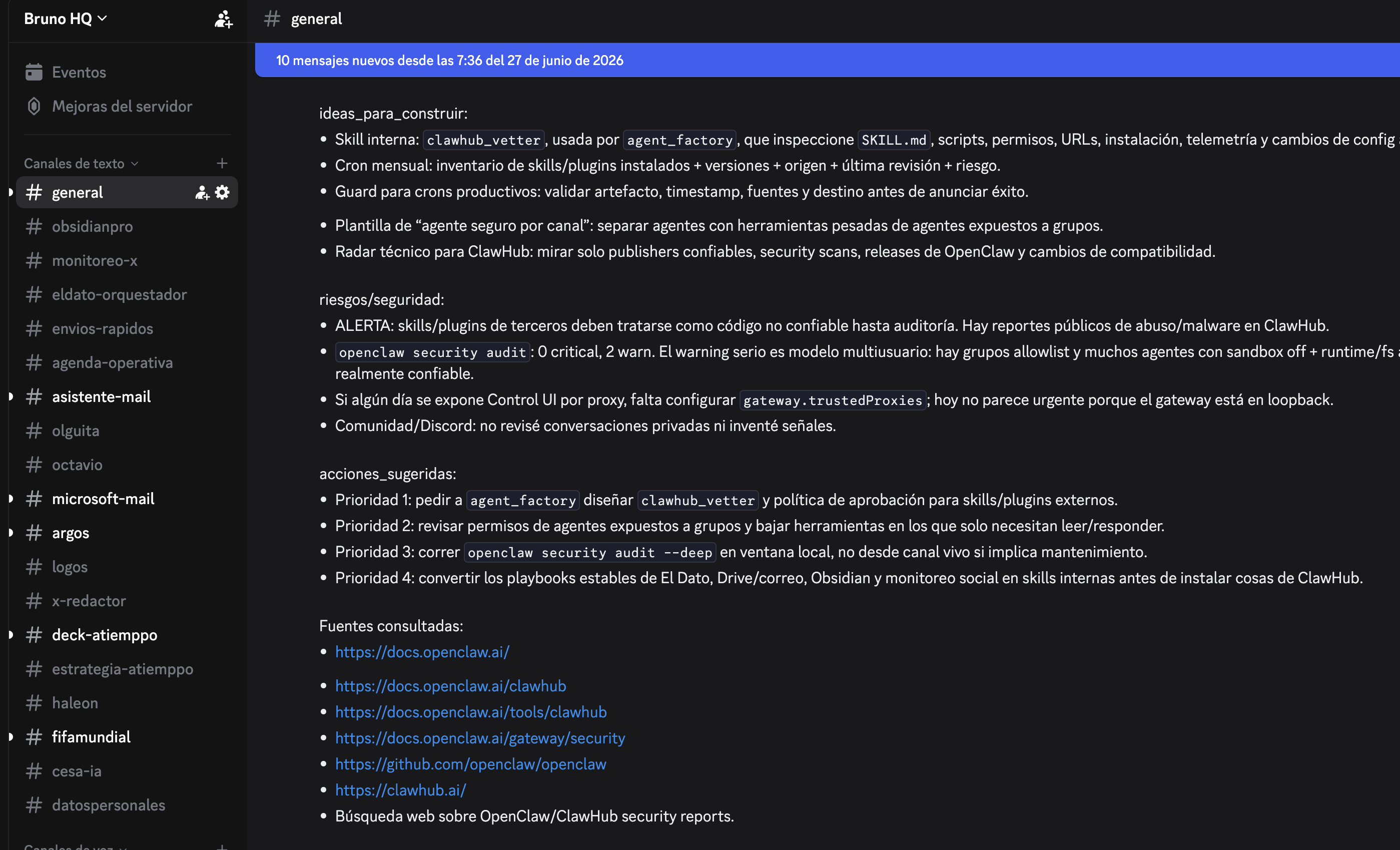
Putting AI to work
For Atiemppo, the opportunity is to build AI projects that don’t stay in conversation.
Projects that automate follow-up. That prepare reports. That query data. That draft documents. That monitor signals. That connect channels. That help sell better, operate better and decide with more context.
Bruno isn’t just an interface. It’s a sample of where working with AI is headed: less demonstration, more execution.
Because in the end, a company doesn’t need another tool to ask questions.
It needs systems that help things happen.
ATIEMPPO Lab series
This article is part of the series AI agents that work on real processes.
Start with the flagship article to see how we connect vision, agents, data, content and applied cases.
See the full series