
Bruno Futbolero and Mundialero: agents that converse with context
One of the best examples for understanding the potential of AI agents isn’t in a boardroom or a corporate presentation.
It’s in a football group chat.
There, a very real situation appears: several people writing at once, short questions, jokes, scores, prediction-pool bets, match excitement, data that changes fast, schedules, tables, line-ups and conversations that don’t always come in an orderly format.
That’s the kind of environment where a traditional chatbot usually fails.
It answers when it shouldn’t. It stays silent when it should speak. It doesn’t understand the group’s tone. It doesn’t know whether “table” means the World Cup standings or the prediction-pool leaderboard. It doesn’t remember the context. It doesn’t check live data. It doesn’t tell a joke, a question and an instruction apart.
That’s why Bruno Futbolero and Mundialero are such a useful case to show what Atiemppo is building with agents and applied artificial intelligence.
They aren’t just agents that talk about football. They’re a practical demonstration of how an AI can interact with diverse people, manage context, use tools, verify information, sustain a fluid conversation and respond differently depending on the moment.
The case: an agent inside a real conversation
In a real conversation nobody writes like they’re filling in a form.
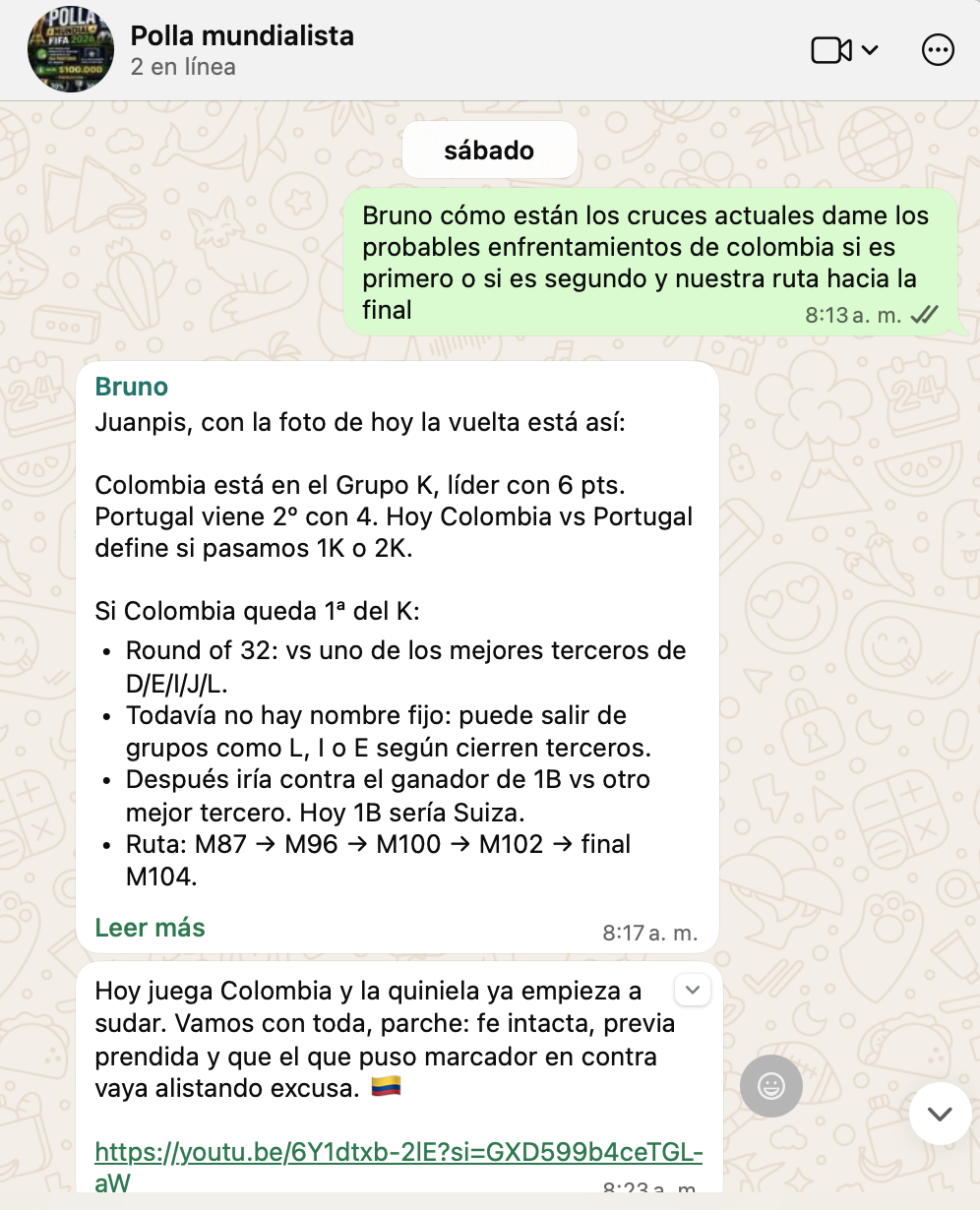
One person asks “what time does Colombia play?”. Another says “I bet 2-1”. Someone shouts “goal”. Another asks how the table looks. Then comes a joke, a doubt about the next match, a request to schedule a game or a question about how the agent works.
For a common AI, all of that is noise.
For a well-designed agent, it’s context.
Mundialero and Bruno Futbolero are meant to operate right there: in groups where the conversation is human, imperfect, fast and social.
The agent shouldn’t answer everything. It should know when to step in, when to wait, when to verify and when to stay quiet.
That difference is key.
What Mundialero does
Mundialero is a specialized agent for following the World Cup, matches, results, tables, line-ups, prediction pools and football banter.
Its work includes:
- answering questions about matches, schedules and national teams;
- checking live data before answering about scores or tables;
- posting daily previews;
- flagging line-ups when they’re confirmed;
- preparing post-match wrap-ups with the result, table and football reading;
- taking part in prediction-pool dynamics;
- adapting the tone to the group;
- distinguishing between official data, editorial reading and group banter.
The important part isn’t that it knows football. The important part is that it acts as an agent with a role, sources, memory, limits and judgment.
If the data changes, it must verify.
If there’s no confirmation, it mustn’t make things up.
If the group is talking among humans, it mustn’t interrupt.
If someone asks a football question, it must answer naturally.
That behavior looks simple from outside, but it requires design.
What Bruno Futbolero does
Bruno Futbolero, in its lab version, uses football as an entry door to demonstrate broader conversational-agent capabilities.
The group plays, asks, laughs, checks matches and tries out dynamics. But underneath there’s a very clear commercial thesis: if an agent can handle a football group with context, it can also handle other environments where there’s information, rules, people and decisions.
The difference is the domain.
In football, the agent answers about matches, tables, schedules and pools.
In a company, that same logic can be applied to:
- commercial follow-up;
- operational reports;
- route or incident monitoring;
- questions about databases;
- document management;
- internal alerts;
- meeting preparation;
- client support;
- user communities;
- support for commercial or technical teams.
Football works as a demo because it’s close, social and demanding at the same time.
People quickly understand whether the agent is alive or just repeating text.
The real capability: managing context
The value of these agents isn’t in answering an isolated question. Many tools already do that.
The value is in managing context.
That means understanding:
- who is talking;
- which group the conversation is happening in;
- what the active topic is;
- which data is stable and which changes;
- which sources should be consulted;
- when a short sentence is enough to answer;
- when it’s necessary to verify before speaking;
- when a long answer gets in the way;
- when the conversation should continue among humans.
In a football group this is very clear.
“Goal” can be just excitement. But it can also be a signal to check the score.
“Table” can refer to the World Cup group or the pool standings.
“I bet 1-1” isn’t a question, but it’s part of a dynamic the agent must understand.
“Schedule that match for me” is no longer conversation: it’s an action.
That kind of reading is what makes the case interesting.
Tools, not just conversation
A useful agent doesn’t just talk. It also queries, executes and leaves evidence.
In the football case, Bruno can rely on sports sources, calendars, tables, match data, historical context and the group’s rules.
That way the answer doesn’t depend on loose memory or a model’s guess.
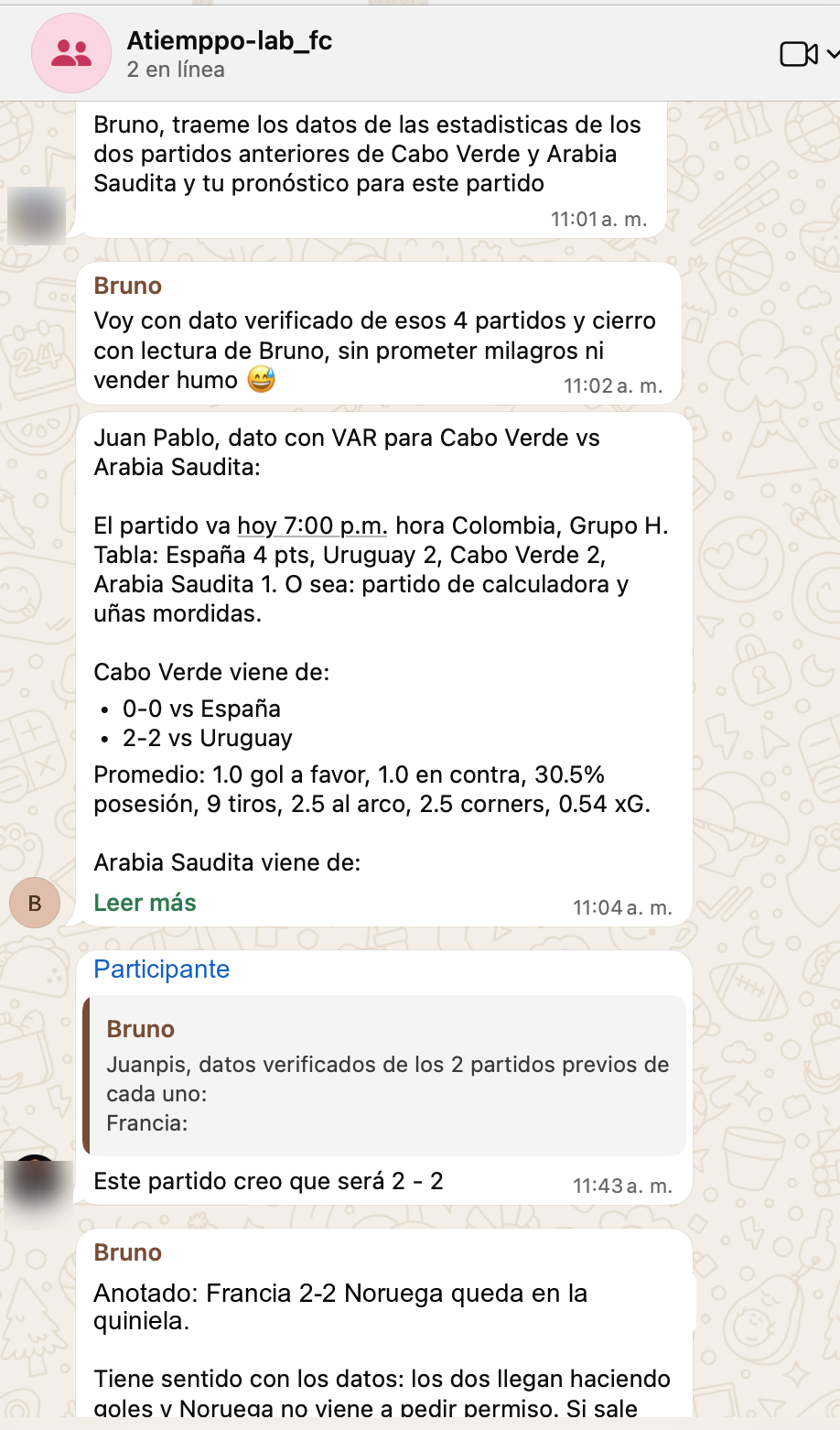
When someone asks about a match, the agent can look up the correct schedule.
When someone asks for a table, it can tell which table is needed.
When there’s a match wrap-up, it can review the score and statistics.
When someone wants to block a match on their calendar, it can turn a conversation into an action.
Conversation becomes the interface.
And that idea is powerful for companies: many tasks don’t start with a perfect form, but with someone writing in a chat.
Tone: a central part of the product
In a conversational agent, tone isn’t decoration.
It’s part of the experience.
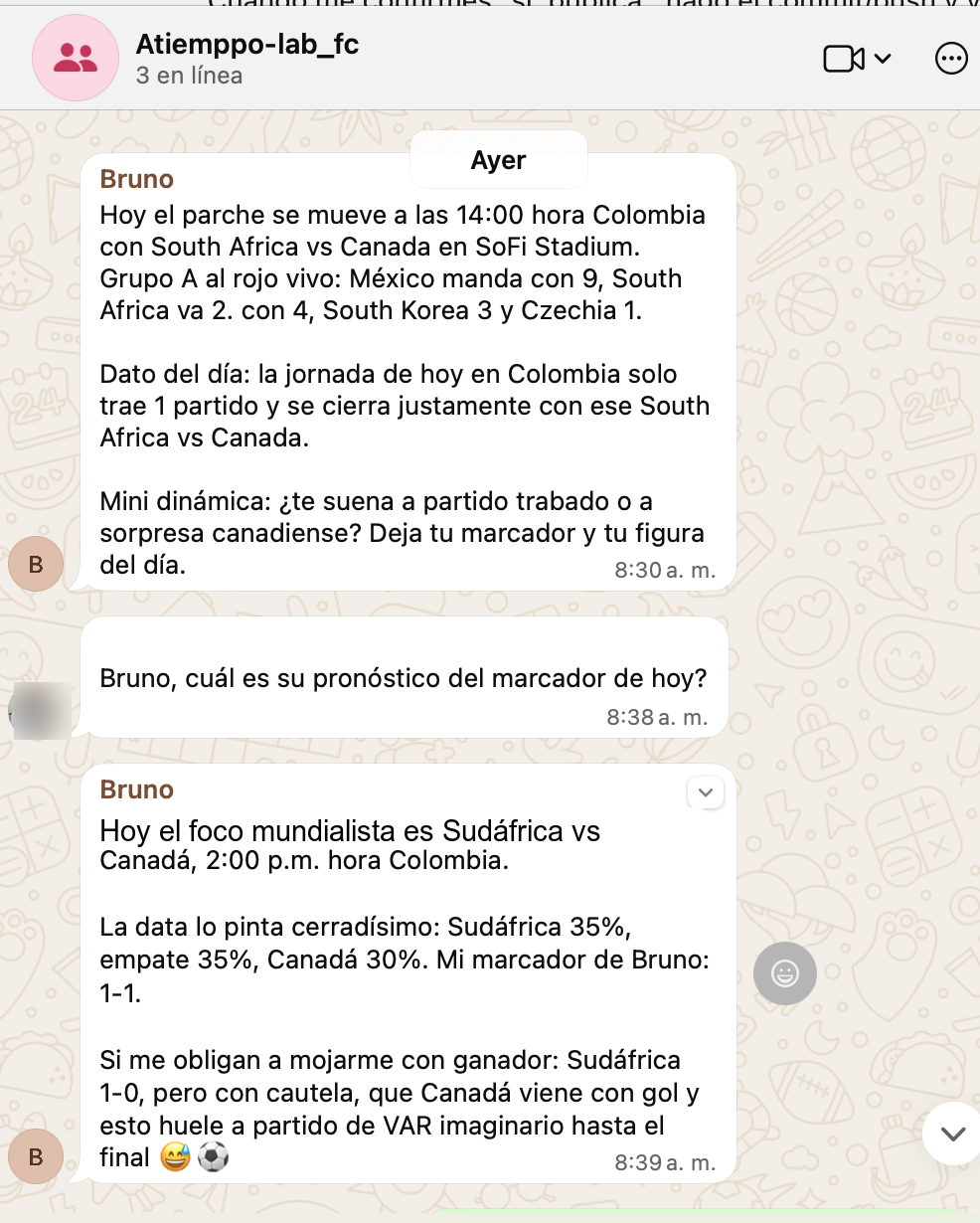
Mundialero can’t talk like a financial report. Nor can it behave like a clown that interrupts everything.
It should sound football-savvy, brief, clear, with humor when it fits and precision when the data matters.
That balance also applies to enterprise agents.
An agent for clients shouldn’t sound the same as an internal analysis agent. A logistics agent shouldn’t sound the same as an educational agent. A community agent shouldn’t sound the same as a billing agent.
Each agent needs:
- a defined audience;
- an appropriate tone;
- intervention rules;
- authorized sources;
- clear limits;
- expected deliverables.
The football case shows that in a simple way: the same Bruno that can speak with humor in a group can also be sober, executive and verifiable in a business context.
Why this case helps sell AI projects
Many companies still imagine AI as an assistant that answers questions.
The Bruno Futbolero case shows something more advanced: an AI that lives inside a social context, interprets signals, queries tools and participates with judgment.
That opens a very concrete commercial conversation.
If an agent can follow a football group, it can also:
- follow a client group;
- handle frequent questions with context;
- read operational information before answering;
- send alerts when there are changes;
- remember a community’s agreements;
- turn messages into tasks;
- summarize long conversations;
- detect commercial opportunities;
- escalate sensitive topics to a person.
The point isn’t to sell “a bot for a chat.”
The point is to show a new work layer: agents that can operate in the channels where people already talk.
AI that knows when not to speak
One of the most underrated capabilities of a good agent is knowing when to stay quiet.
In human groups, answering too much can be worse than not answering.
Mundialero should step in when it adds something: a fact, a clarification, a dynamic, an answer, an action. But it shouldn’t get into every joke or cut off the natural conversation.
That rule is fundamental for any enterprise agent.
An AI agent shouldn’t become noise. It should reduce noise.
It should come in when there’s value and step out when it’s not needed.
From social game to commercial architecture
Football makes the case easy to understand.
But the mental architecture behind it is serious:
- a clear role is defined for the agent;
- it’s connected to real conversation channels;
- it’s given sources and tools;
- privacy and tone rules are set;
- it’s decided when it responds and when it doesn’t;
- real cases are tested;
- the behavior is adjusted according to what happens.
That same process serves to design agents in logistics, sales, education, support, data analysis, operations tracking or document management.
The football case is a friendly demo of something much bigger.
What Atiemppo wants to show
With Bruno Futbolero and Mundialero, Atiemppo can show a powerful idea:
artificial intelligence isn’t only useful for generating text, but for participating in live processes.
A live process has people, context, rules, tools, sources, changes, mistakes, jokes, decisions and follow-up.
That’s where agents start to have value.
They don’t replace human conversation. They accompany it.
They don’t invent authority. They consult sources.
They don’t always answer. They answer when it makes sense.
They don’t just explain. They execute.
A simple example to explain something complex
Bruno Futbolero is commercially useful because it brings a complex idea down to a scene anyone understands.
A football group is chaotic, social and fun. If an agent can operate well there, with live data and the right tone, the question arises on its own:
what could it do in a company if we connect it to the right sources?
That’s the conversation Atiemppo wants to open.
Not from theory.
From practical cases.
From agents that do things.
From experiences where people can touch the AI, test it, question it, challenge it and see how it responds.
The opportunity
Mundialero and Bruno Futbolero can become a very valuable piece of commercial demonstration:
- as a web case;
- as a demo in meetings;
- as an experience in pilot groups;
- as an example to explain OpenClaw without jargon;
- as a bridge toward specialized-agent projects;
- as a way to show memory, tools, tone and context in action.
The message is clear: if AI can accompany a football conversation with judgment, it can also accompany business processes with information, rules and follow-up.
That’s the real value of agents.
Not that they talk a lot.
That they understand the context, use tools and help make things happen.
ATIEMPPO Lab series
This article is part of the series AI agents that work on real processes.
Start with the flagship piece to see how we connect vision, agents, data, content and applied cases.
See the full series