
AI agents for logistics: the Novedades en Vías case
Artificial intelligence starts to generate real value when it stops being a demo and becomes a concrete operation.
At Atiemppo we work with that idea: not building agents to show off technology, but to solve real problems of information, tracking and decision-making. One of those cases is Novedades en Vías, a specialized agent that monitors logistics corridors in Colombia and turns scattered signals into reports that are useful for operations.
The case is easy to understand: in transport, a road incident can change a route, delay a delivery, affect a commercial promise, alter a port operation or generate extra costs before the information reaches every team in an organized way.
The challenge isn’t that information doesn’t exist. The challenge is that it’s fragmented.
Part shows up in official sources. Part in road concessions. Part on social media. Part in local outlets. Part in authority reports that change throughout the day. And meanwhile, the traffic, customer service, planning and operations teams need to decide.
That’s where a specialized agent starts to make sense.
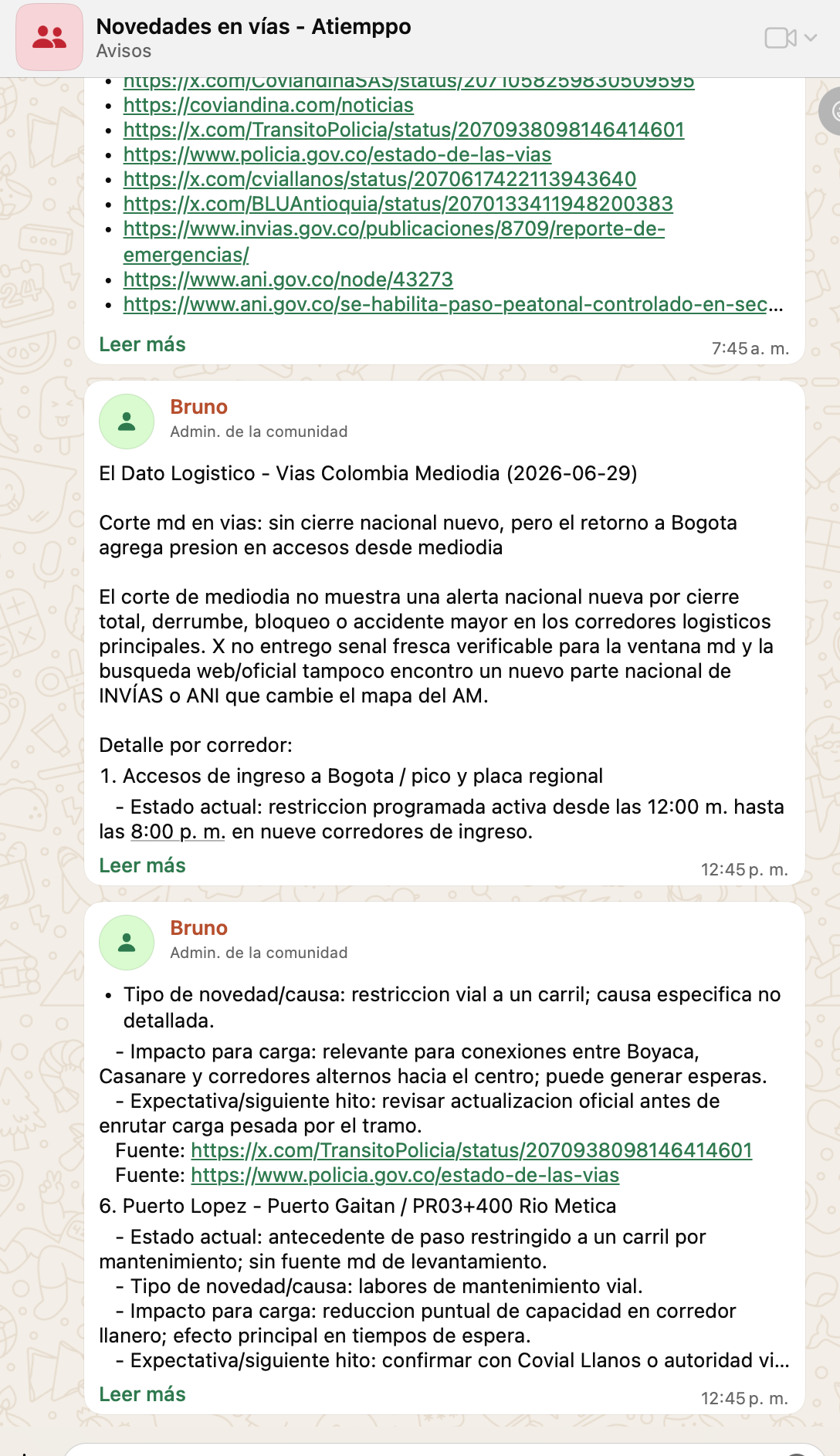
From manual monitoring to operational intelligence
Novedades en Vías tracks the country’s main logistics corridors and nodes throughout the day. It looks for closures, restrictions, alternate routes, landslides, accidents, roadworks, emergencies, protests, weather impacts and any signal that could affect cargo transport.
But its value isn’t in listing news. Its value is in organizing information with logistics judgment:
- what changed since the last cutoff;
- what’s still active;
- which corridor needs watching;
- what source backs the update;
- what impact it could have on cargo, dispatches, supply or port access;
- what can’t be stated yet.
That last part is important. A useful agent shouldn’t just find information; it should also know when there isn’t enough evidence. In logistics, flagging an event as “resolved” when it isn’t yet confirmed can be as costly as not detecting it.
Multiple sources, a single reading
The agent consults and cross-checks official, institutional, operational and open sources. Among them are the National Police, INVÍAS, Colombia’s Logistics Portal, ANI, road concessions, authority and operator accounts on X, and regional outlets when they provide early signals.
The difference is that not all sources are treated equally. A local report can serve as an alert, but it doesn’t carry the same weight as an official update or a direct communication from a concession. The agent helps separate signal from noise and deliver a more reliable reading for those who have to act.
This is applied AI in a practical way: it doesn’t replace the authorities or human teams, but it gives them an additional layer of monitoring, comparison and synthesis.
Three cutoffs a day for real decisions
Novedades en Vías operates with three daily moments:
- morning;
- midday;
- afternoon.
That cadence matches the way logistics decisions are made: vehicle departures, adjustments during operations and planning for the end of the day or the next dispatch.
Each cutoff compares the current situation with the previous report. That way, the system doesn’t start from scratch every time. It keeps continuity, identifies changes and prevents open incidents from disappearing off the radar just because they stopped being mentioned in a recent search.
For a company, that continuity can translate into better decisions: adjust routes, anticipate conversations with clients, prioritize vehicle tracking, review delivery windows or activate backup plans before the problem escalates.
Tracking strategic corridors
The agent is designed to look at the road network from a logistics perspective, not just an informational one.
That’s why it tracks corridors and nodes such as Bogotá - Villavicencio, Buga - Buenaventura, the Panamericana in Cauca, Ruta del Sol, Transversal del Sisga, Ciénaga - Barranquilla, Boyacá - Casanare connections and the port access routes of Cartagena, Barranquilla, Santa Marta and Buenaventura, among others.
The question isn’t only whether a road is closed. For a cargo operation, a single-lane pass, a stop-and-go, a tonnage restriction, scheduled roadworks or a regional emergency can alter times, costs and commitments.
The agent turns that tracking into an actionable reading: what’s happening, where it’s happening, how reliable the source is and what should be watched in the next cutoff.
What this case shows about AI projects
Novedades en Vías isn’t just an editorial product. It’s a sample of how AI agents can be built for specific processes.
The logic can be applied to many fronts:
- tracking logistics risks;
- monitoring clients or suppliers;
- reading public and regulatory sources;
- commercial alerts;
- analyzing conversations and documents;
- generating periodic reports;
- supporting operational, commercial or executive teams.
The pattern is the same: define a concrete problem, identify reliable sources, build an operational memory, design a review flow and deliver information at the moment it’s useful for deciding.
That’s the kind of AI project Atiemppo seeks to develop: specialized agents that work on real cases, with traceability, judgment and a useful output for the business.
Bruno, OpenClaw and specialized agents
Behind this approach there’s an agent architecture. Bruno, our orchestrator built on OpenClaw, coordinates flows, tools and specialists depending on the task. Some agents monitor sources. Others write, edit, query databases, review documents, prepare reports or run scheduled routines.
The promise isn’t to have “a chatbot” that answers everything. The promise is to design agents with a clear role, memory, sources, limits and deliverables.
That shift matters. A generic agent can answer a question. A specialized agent can sustain a process.
Novedades en Vías is an example: it takes an everyday logistics problem, turns it into a recurring flow and delivers a piece that helps operate better. It isn’t AI as decoration. It’s AI as decision infrastructure.
From idea to project
For many companies, the question is no longer whether they should use artificial intelligence. The question is where it makes sense to start.
Our answer is simple: start where there’s scattered information, repeated decisions, manual tracking, periodic reports or teams spending time on tasks that could be better structured.
That’s where specialized agents can generate value quickly.
Novedades en Vías shows that path. A concrete case, an operational need, real sources, daily cutoffs and an output designed for decision-making. That’s the kind of AI we want to build with our clients: practical, traceable and connected to the business.
At Atiemppo we believe the advantage isn’t in talking about agents. It’s in putting them to work.
A channel to follow the updates
The project also has a WhatsApp group to receive cutoffs and road-update reports.

You can join from this link: Novedades en vías - Atiemppo.
Live project
Novedades en Vías turns scattered monitoring into operational cutoffs for logistics decisions.
Join the WhatsApp group or go back to the flagship article to see how we connect vision, agents, data, content and applied cases.
Join the group See the full series