Yesterday the 2026 World Cup kicked off and I want to tell you how we decided to take advantage of it to run an experiment we’ve been imagining for months: taking Bruno out of my AI workbench and putting it into a football group chat.
Not into a perfect demo.
Not into an individual screen.
Not into a silent lab.
Into a real WhatsApp group, with real people, real questions, jokes, schedules, excitement and shared context.
This isn’t a traditional edition of El Dato Logístico. Or rather, it is, but by another path. Today we won’t only talk about transport, costs, corridors, SICETAC or live reports. Today we’ll talk about football, WhatsApp and a question that’s changing the way I work with artificial intelligence.
Because the World Cup started on the pitch, but for us it also started somewhere else: in an AI workbench we’ve been building for months.
The question isn't only what an AI can answer. The question is where it lives, with what context it participates and how it helps move a real conversation.
My AI workbench
I don’t mean a physical bench. I mean a work system.
A place where messages, documents, databases, ideas, meetings, requests, files and questions come in. A place where those signals don’t stay loose, but start connecting with memory, sources, agents and concrete outputs.
For a long time, AI felt like a separate window. You’d open ChatGPT, ask something, copy, paste and go back to the real work. That was already useful. But over time I realized the problem wasn’t only having better answers.
The problem today is connecting AI with the flow where things actually happen.
That’s where I began building my AI workbench.
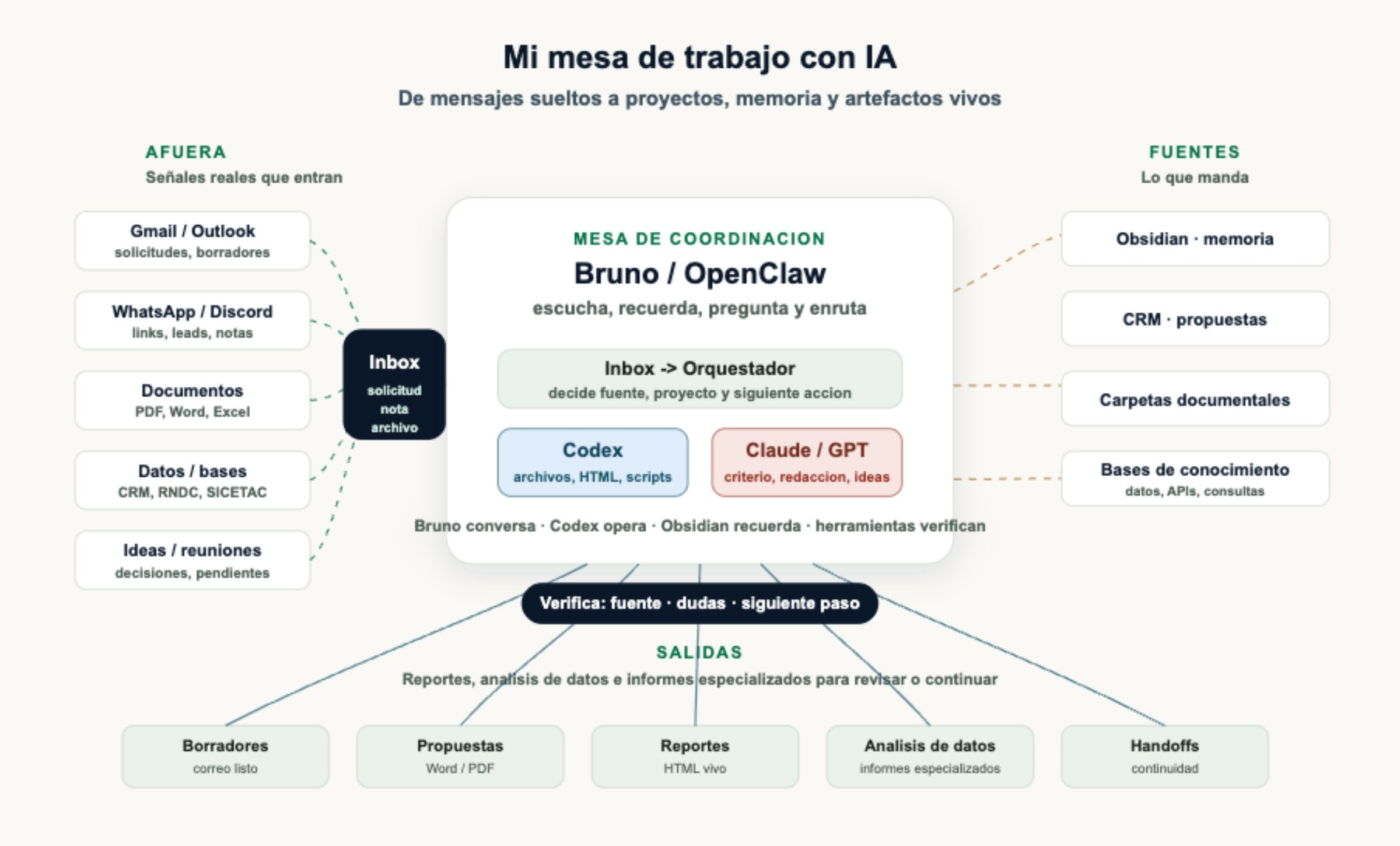
On that bench several pieces coexist: documents, databases, live reports, Obsidian, Codex, GPT, Claude, OpenClaw and Bruno.
Bruno is the name we’ve given one of those agents.
Sometimes it converses. Sometimes it asks. Sometimes it summarizes. Sometimes it queries. Sometimes it helps organize. And when it’s well designed, it doesn’t just write nicely: it helps move the work.
But until now that bench lived mainly with me: on my screen, in my documents, in my projects and in my workflows.
Then a natural question appeared:
What happens when artificial intelligence stops living on an individual screen and starts taking part in a real group?
The World Cup as a social lab
The World Cup was the perfect excuse to test it.
Not because football is ATIEMPPO’s core business. Not because we wanted to run a prediction pool with excessive technology. But because a World Cup has something any work system needs to test: constant conversation, shared interest, real questions, changing information, excitement, humor, mistakes, coordination and context.
In other words: a live group.
That’s how Atiemppo Lab FC was born, a WhatsApp group to talk about the World Cup, run prediction pools, review matches, ask about schedules, request analysis, play with data and test something deeper: how an AI agent behaves when it enters a space shared with real people.
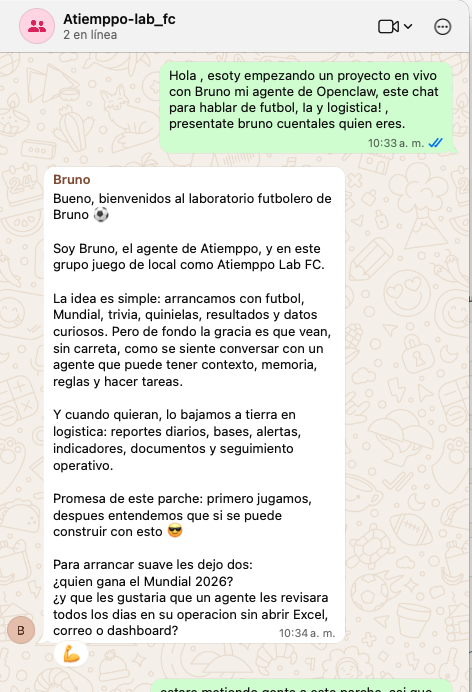
That step changes the conversation.
Because using AI to help you write or analyze in private is one thing. Letting an agent enter a space with more people, more tones, more expectations and more responsibility is another.
There, AI stops being just an individual tool.
It starts behaving like part of a bench.
And that forces you to design it differently.
Designing Bruno not to answer everything
Bruno entered the group connected through OpenClaw.
The idea was for it to participate as a football agent: query information, answer questions, review matches, do simple analysis, remember the group’s rules and, above all, learn to behave within a collective conversation.
We had to learn to design Bruno not just to answer, but to recognize how it behaves when it wants to answer everything. We also had to give it controls to avoid making up information, verify the data it generates and read the messages it receives better.
That sounds technical, but it’s actually deeply social.
An agent in a group needs to tell a question from casual conversation. It has to understand when it can step in and when its best contribution is to stay out. It must recognize who it’s interacting with, what tone the group has, what rules it must respect and what kind of handling it can do: query, summarize, remember, organize, alert or propose a next step.
That learning is harder than writing a good answer.
Because in a real group AI doesn’t just produce text. It participates in a social dynamic.
The World Cup gives us a friendly way to test it:
“Bruno, who plays today?”
“Bruno, send us an analysis.”
“Bruno, how did Mexico do?”
“Bruno, what forecast do you see for this match?”
“Bruno, schedule me a reminder for the next match.”
There was even room for more playful questions, which are just as important to test the agent’s social behavior:
“Bruno, did you get it wrong? Make fun of yourself.”
“Bruno, which team do you support?”
“I’m sure you’re a fan of such-and-such team.”
That kind of interaction looks like play, but it forces the agent to handle identity, tone, context and limits without breaking the group’s trust.
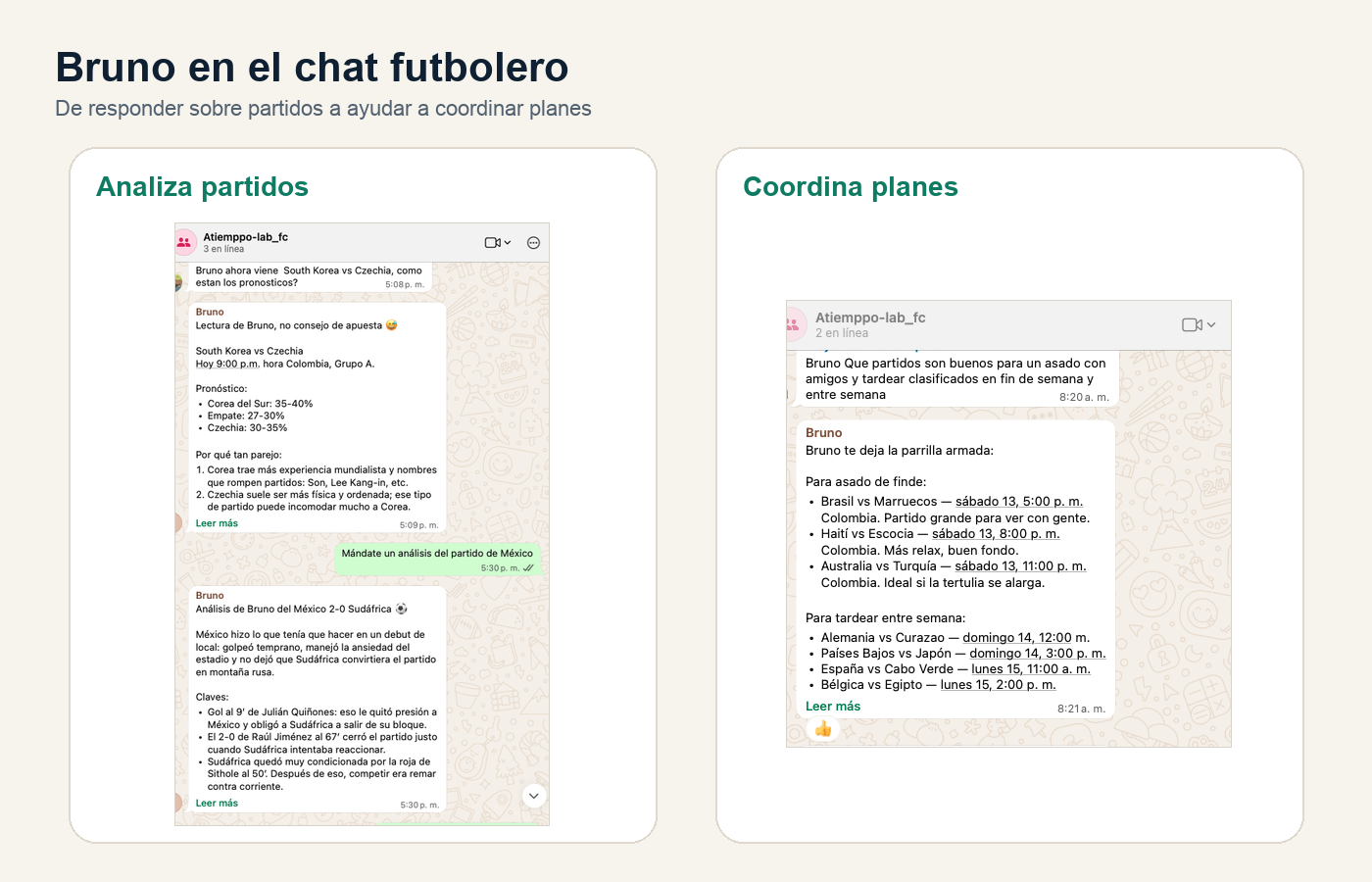
From analyzing matches to coordinating work
When Bruno analyzes matches and helps coordinate plans, the interesting part isn’t just football.
It’s the pattern.
An agent with context can query, summarize, answer with judgment and help organize actions within a group. Behind a simple answer there’s a more serious architecture: an agent with context, sources it must consult, participation rules, memory of the group, limits and a conversation that doesn’t belong to it, but in which it can help.
Because the same logic we use for Bruno to review a match can serve a real workbench.
It can serve to summarize conversations, remember commitments, consult documents, review databases, prepare drafts, track tasks, connect scattered information and help a team keep context.
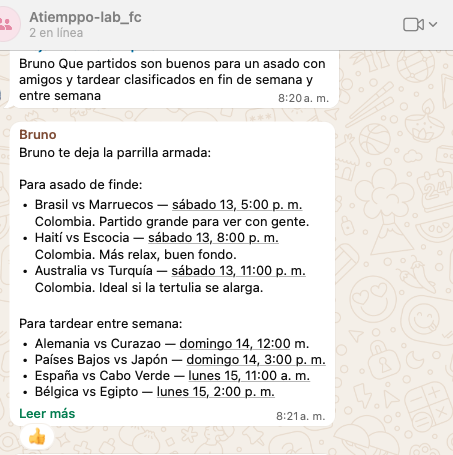
At El Dato Logístico we’ve been talking a lot about live reports, queryable data and moving from the static PDF to tools you can explore.
This experience goes in the same direction: moving from AI as an isolated answer to AI as a work system.
And that’s why this edition is special.
Because the 2026 World Cup lets us test it in a close, light and fun environment. But the lesson can serve logistics, foreign trade, transport, supply, planning, sales, operations, customer service and project management.
The deeper reading
The future of AI isn’t only in improving individual productivity. It’s also in improving the way groups work, learn, coordinate and decide together.
Until now many of us used AI as a separate window: we’d open ChatGPT, ask something, copy, paste and close. That’s already useful. But what’s coming is more interesting: agents that live close to our conversations, documents, clients, data, projects and decisions.
An AI that isn’t only an answer, but a useful presence within the workflow.
And note: that doesn’t mean replacing human conversation.
A well-designed agent doesn’t replace judgment. It forces it to be made explicit. It doesn’t replace trust. It has to earn it with context, sources and limits. It doesn’t replace the team. It helps the team remember, consult, organize and advance better.
That’s why this experiment doesn’t stay in football.
Atiemppo Lab FC is a fun version of something we want to bring to more teams and organizations: building AI workbenches that make practical sense.
Not AI for the trend. Not AI as a toy. Not AI as one more chat.
AI connected to real processes. To real documents. To real data. To real conversations. To real decisions. To real people.
Sometimes the best AI isn't the one that answers fastest. It's the one that better understands when its intervention actually helps.
The invitation
I want to invite the members of El Dato Logístico who’d like to join this experience.
The idea is simple: live the World Cup, test Bruno in a real group and learn together what happens when an AI agent participates in a shared conversation.
It isn’t just about playing. It’s also about observing what works, what feels uncomfortable, what helps, what’s excessive, what rules are missing and how an AI can participate without damaging the conversation.
This post is special because of the World Cup, but also because it marks a transition I think we’ll see more and more: from using AI individually to building AI workbenches; from asking for answers to designing systems; from loose prompts to agents with context; from static documents to live reports; from isolated chats to coordinated conversations.
Maybe the first step isn’t having the perfect agent.
Maybe the first step is making it a seat at the table.
And in this case, the table started with football.
Open experiment
If you're part of the El Dato Logístico community and want to join the Atiemppo Lab FC test group, reply with the word BRUNO.
We'll live the World Cup, test the agent, learn in public and understand together what can happen when AI starts participating in real groups.
Go to El Dato LogísticoEditorial note: this edition uses the 2026 World Cup as a social lab. The tournament’s official opening was on June 11, 2026, and this post was prepared on June 12, 2026.